Presence Protected: What That Actually Means for Your Wedding Day
A wedding can be beautifully planned and still feel surprisingly hard to be present for.
Not because anything is necessarily going wrong. Sometimes the problem is simply that too many people who are supposed to be experiencing the day are also responsible for managing it.
The couple is answering vendor questions. A parent is checking whether transportation arrived. A wedding-party member is trying to locate someone for photos. A friend is watching the clock because nobody else knows when dinner is supposed to begin.
That is what we mean when we say: Presence protected.
It is more than a line in our tagline. It is one of the outcomes thoughtful planning, Wedding Management, and strong event logistics are designed to create.
Protecting your presence
You should be able to experience your wedding without constantly switching between being the person getting married and being the person managing the wedding.
There will always be decisions that belong to you during the planning process. But once the celebration begins, the questions should increasingly move away from you.
Where should the florist unload? Who is confirming the photographer knows about a timing adjustment? Has the ceremony space been checked? Is everyone who needs to be lined up actually there? What happens if one part of the timeline runs ten minutes behind?
Those are operational questions. They need answers, but they do not need to become your job in the middle of your wedding day.
Protecting your presence means creating enough preparation and structure beforehand that you can spend more of the day actually inside the moments you worked so hard to create.
Protecting the people you love
Your wedding party, parents, siblings, and closest friends are often the first people willing to jump in when something needs to be handled. That generosity is wonderful. It also does not mean they should become the unofficial coordination team.
The people standing beside you were invited because they matter to you. They should be getting dressed with you, taking photos, catching up with family, enjoying dinner, dancing, and being part of the memories — not spending the day tracking down vendors or troubleshooting logistics.
Professional support creates somewhere else for those responsibilities to go.
That matters whether you need Wedding Management to bring an already-planned celebration together or Partial Planning because there are still unfinished decisions, vendors, or logistics that need professional guidance before the final phase begins.
Protecting the guest experience
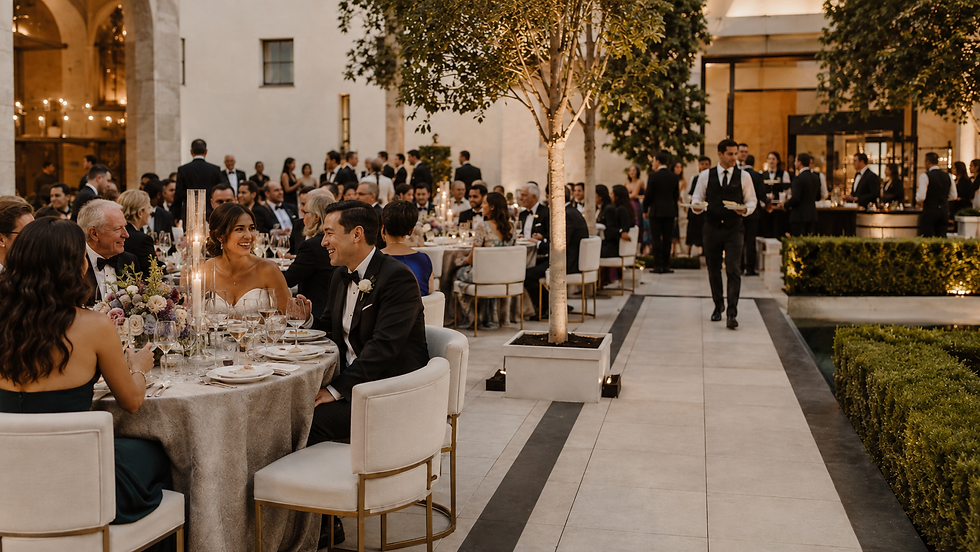
Presence protected extends beyond the couple and wedding party. It includes the people you invited to celebrate with you.
Guests may never know how much planning went into their experience — and in many ways, that is the point.

They notice whether they understand where to go. Whether transitions feel natural. Whether there is an awkward forty-minute gap with no communication. Whether elderly relatives can comfortably navigate the space. Whether the ceremony can be heard. Whether dinner service flows. Whether they know what happens next.
Guest experience is built through hundreds of small logistical decisions: signage, transportation, accessibility, timing, seating, vendor communication, weather plans, room transitions, and the way the timeline accounts for real human movement instead of assuming everyone teleports from one moment to the next.
A wedding does not need to feel rigid to be well managed. In fact, good logistics often make the celebration feel more relaxed because the structure is doing its work quietly in the background.
Presence is protected before the wedding day
The calmest wedding days are rarely the result of someone being exceptionally good at putting out fires. They are usually the result of people identifying potential problems before they become fires at all.
That means confirming vendor responsibilities. Building a realistic wedding-day timeline. Understanding the venue. Reviewing contracts. Clarifying setup and breakdown expectations. Knowing who owns each task. Creating contingency plans. Making sure important details are not living only in one person's head.
This is also why true Wedding Management begins before the wedding day. The final weeks are when the separate pieces of your planning need to become one coordinated event.
And if there are still significant pieces unfinished? That is often the point where Partial Planning makes more sense. The goal is not to squeeze every couple into the same level of service. It is to identify how much support is actually needed to get from where you are now to a wedding that can be executed intentionally.
A timeline should create breathing room
A good wedding timeline creates structure. A great one creates breathing room.
That does not mean padding the day with empty hours. It means understanding where people need transition time, where vendors need setup time, where photographs need flexibility, and where the couple deserves a moment that is not immediately followed by someone saying, ‘Okay, next thing.’
The goal is not to control every second. The goal is to create enough structure that when something shifts — because something almost always does — the entire day does not unravel with it.
Your wedding should be something you experience
There is a difference between having a wedding that looks beautiful from the outside and having one that you were actually able to experience from the inside.
You deserve both.
Whether your wedding includes long-standing traditions, completely reimagined ones, or none of them at all, thoughtful planning should ultimately protect the people at the center of the celebration.
That is the heart of presence protected: the logistics are still being handled, the questions still have somewhere to go, and the celebration can keep moving — without requiring you or the people you love to manage it from inside the moment.
If you are planning a wedding in Sarasota or Southwest Florida and are starting to wonder who will carry the logistics when the planning becomes the actual wedding, tell us about your celebration. We can help you determine whether Wedding Management or Partial Planning is the right level of support.
Tradition optional. Execution intentional. Presence protected.


Comments